The Best Digital SLR for Action

If you're looking for the best digital SLR for action photography, then I'm going to assume you spend most of your time snapping pictures of things that go really fast.
Now "things that go fast" does not necessarily mean Formula One race cars.
Let's say that you want to take lots of pictures of your dog. Since the majority of dogs aren't willing to sit still for a portrait you need a camera that can capture a fraction of a second of time.
One moment you might have a priceless image, and the very next all you'll get is a picture of your dear pet running away.
There are two main features you need to consider when looking for the best SLR for action: a fast multi-point autofocus and a fast continuous speed.
|
Autofocus
Getting a camera with a superior autofocus system is one of the key ingredients for good action shots.
If you're taking pictures of subjects moving either past the camera or directly toward it, the autofocus needs to constantly adjust to keep everything in focus.
Some systems make these micro-adjustments quite fast, while others take their time.
The autofocus also needs to peform well in low-light conditions.
For example: you want to take photos of a high school basketball game. I've never been inside a very well-lit gymnasium (although I'm sure they exist) and some autofocus systems slow down when there's less available light.
How can you tell how well the autofocus performs on a camera?
Unfortunately the best answer here is this: you have to try it out yourself. Find a local camera store and test out the different models to see how quickly the autofocus responds.
If you're able to find a camera that locks focus in seconds even in the dim indoor light of a camera shop, then you know it will do fine under a variety of other conditions.
Continuous Speed
There are three main ways a digital SLR camera can capture photos:
- One shot at a time
- Continuous consecutive photos
- One shot delayed by a timer
Mode #2 is the important one for action photographers.
In continuous shot mode, the camera will keep snapping pictures as fast as it can so long as you keep holding down the shutter button.
This is a great tool for capturing a burst of images (5 - 10) right at the moment when the action is at its peak. Since it's hard for your eye to see a single moment in time, one frame of that burst may stand out more than the others when you review them later.
Not all digital SLRs capture bursts of consecutive images at the same speed. The most common burst speed is 3 photos per second, and you'll find this on many of the less expensive models on the market.
If action photography is your passion, then the best digital SLR for you will have a continuous speed of 5 photos per second or more.
ISO Performance
The last important camera feature to consider if you're an action enthusiast is how well the camera handles high ISO noise.
Here's a quick primer when it comes to a camera's ISO setting:
- The ISO setting affects how quickly the camera's sensor absorbs light
- A high ISO number means the sensor is absorbing light faster
- The faster light is absorbed by the sensor, the faster the shutter speed you can use
The main reason that ISO is important for action photography is because it is your primary tool to ensure that you're action photos don't turn out blurry.
In order to freeze a fast-moving subject you MUST use a fast shutter speed. Depending on the available light, getting a fast shutter speed may be challening. Let's look at some examples:
| SUBJECT | LIGHT | ISO | SHUTTER | ANALYSIS |
|---|---|---|---|---|
| Child running and playing outside | Bright sunlight | 100 | 1/500th of a second | The shutter speed is plenty fast to freeze the motion of the child - there should be no visible blur in your photos. |
| Basketball players in a gym | Fluorescent lights | 100 | 1/60th of a second | If you leave your ISO at 100 for shots of a basketball game, EVERY shot you take will be blurry - the shutter speed at ISO 100 is not fast enough to freeze the motion of the players. |
| 3200 | 1/500th of a second | By increasing the ISO, you also increase your shutter speed and NOW it is fast enough to get clear shots of the players in action. |
So using a high ISO solves the image blur problems that you might have when shooting action shots. However, high ISO values also add a lot of noise/grain to your photos which can reduce the image quality.
Some cameras are better than others at keeping high ISO noise to a minimum, so this is something you'll want to look for in the best digital SLR for action.
Best Action Digital SLRs
So which of the cameras currently available have fast autofocus, fast continuous speeds and good high ISO noise performance?
There are two to consider. One is only slightly faster than the other, but it will cost you more to get it.
Sony ALPHA SLT-A65
| Release Date: October 2011 | ||
| Key Features | 24.3 megapixels, OLED viewfinder, 10 photos per second, flexible 3 inch LCD | 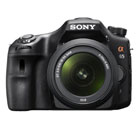 |
| Uniqueness | Translucent Mirror, OLED Viewfinder | |
| Great For | Action and Sports | |
| Level | Beginner to Intermediate | |
| Competitors | Canon 600D, Nikon D5100 | |
| If you "feel the need for speed" then the SLT-A65 might just be the right camera for you. Its 15-point autofocus system is paired with a translucent mirror which allows for continuous autofocus in live view and movie modes. In addition, the top speed of 10 photos per second and ISO up to 16000 will let you freeze subject motion in all kinds of available light. The flexible LCD screen can be twisted in all directions and the new high-resolution OLED viewfinder can be used when the sun is too bright to see the LCD. | ||
| Price (With Lens): $1,000 USD | ||
Sony ALPHA SLT-A77
| Release Date: October 2011 | ||
| Key Features | 24.3 megapixels, OLED viewfinder, 12 photos per second, built-in GPS | 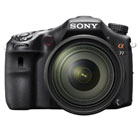 |
| Uniqueness | Fast Continuous Speed | |
| Great For | Action and Sports | |
| Level | Intermediate to Advanced | |
| Competitors | Canon 7D, Nikon D7000 | |
| The Sony A77 aims to compete with Canon and Nikon by offering the fastest continuous speed on any DSLR to date: a whopping 12 photos per second. A unique articulated LCD screen can be viewed from virtually any angle (even standing in front of the camera). Toss in full HD 1080p video, sweep panorama, 19-point autofocus, an electronic OLED viewfinder, built-in GPS and an ISO range from 100 to 16000 and you have a camera to be reckoned with. | ||
| Price (With Lens): $2,000 USD | ||
Related Links
 Best Digital SLRs Best Digital SLRs |
Digital SLR Home | Sony Digital SLRs |