


Sigma Digital SLR Cameras |
Page updated: July 2007 |
The first Sigma digital SLR camera made a big splash when it first arrived.
It was the very first digital SLR to incorporate a brand new type of sensor: the Foveon X3.
Rather than just packing in a higher number of megapixels, the Foveon X3 sensor was a intended as astep toward revolutionizing the digital SLR sensor market.
All this was back in 2002.
Today there are only 2 Sigma digital SLR cameras, and they are still the only two that use the X3 sensor.
  |
The Foveon X3 Sensor
Think of a digital SLR camera sensor as a chessboard.
Each individual square of the chessboard is a light-gathering element called a photodetector or pixel.
With a traditional sensor, a photodetector can only capture one color of light: red, green or blue. The different colors are arranged in a checkerboard pattern so that they don't overlap.
The camera then combines the information captured by each individual color sensor into the final image.
With the X3 sensors used in the Sigma digital SLR cameras, each photodetector can capture all three colors. Rather than a checkerboard, red, green and blue are layered on top of each other.
If a photosensor detects a blue color, the blue layer activates to capture the color.
Benefits of the Foveon X3 Sensor
If this all seems overly technical, it is.
Here's the real end result for the person who is interested in how this affects photographs:
- Accurate Color - Since there is no checkerboard pattern of color sensors, each sensor can capture exactly the color it is supposed to
- Reduced Processing - The camera has to do less work to reconstruct an image correctly since each pixel in the sensor is capturing the right color
- Higher Image Quality - Checkerboard sensors can create patterned photos, but with the X3 these patterns disappear
You can really see how the Foveon X3 sensor works with this Foveon X3 technology overview at DPReview.
Sigma Digital SLR Cameras
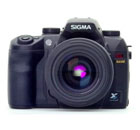
Sigma SD14 |
Release Date | December 2003 |
|
|
| Key Features | 10.2 megapixels, dust control | ||
| Uniqueness | Foveon X3 Sensor | ||
| Great For | Fine art and professional work | ||
| Level | Advanced | ||
| Avg. Kit Price | $1,000 | ||
| Competitors | None | ||
| The SD-10 is the 10 megapixel predecessor to the SD-14. Since there was a considerable amount of time in betwen the release of the SD-10 and the SD-14, this camera is now quite hard to find brand new. | |||
|
|||
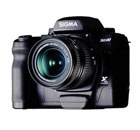
Sigma SD14 |
Release Date | March 2007 |
|
|||
| Key Features | 14 megapixels, dust control | ||||
| Uniqueness | Foveon X3 Sensor | ||||
| Great For | Fine art and professional work | ||||
| Level | Advanced | ||||
| Avg. Kit Price | $1,200 | ||||
| Competitors | Canon 30D, Nikon D200 | ||||
| The SD-14 is Sigma's latest entry into the high-end digital SLR camera market. While its sensor packs in more megapixels than either the Canon 30D or the Nikon D200, its speed is significantly slower than both of those cameras. | |||||
|
|||||
 at Shopzilla

 Digital SLR Guides Digital SLR Guides |
Digital SLR Home | Sony Digital SLR |


