Other Digital SLR Cameras |
Page updated: February 2009 |
When it comes to digital SLR cameras, there are 5 main players: Canon, Nikon, Olympus, Pentax and Sony.
Canon and Nikon are the dominant leaders in the marketplace, providing the greatest number of camera models to choose from.
Following in a pack close behind are Olympus, Pentax and Sony.
But there are a handful of other digital SLR camera manufacturers that quietly churn out cameras in the background, that don't get the same exposure as the ones from the companies listed above.
Fuji Digital SLRs
The Fuji sensor actually captures two images for every photo you take.
One image is what you'd expect to get from a standard digital SLR sensor, and the other is a darker image designed to capture highlight details.
The camera combines the two images for the final result, which effectively "extends" the dynamic range of the Fuji digital SLR sensor.
It's a huge benefit for anyone who uses an on-camera flash for portrait work or who typically takes photos where there is extreme contrast (portraits on sunny days).
It's also a challenge to the more popular manufactuers to produce "smarter" sensors rather than just sensors with more megapixels.
You can read more technical information about the Fuji digital SLR sensor at ePHOTOzine.
Fuji S5 Pro |
Release Date | February 2007 |
 |
| Key Features | 12.3 megapixels, compatible with Nikon lenses | |
| Uniqueness | Wide dynamic range | |
| Great For | Wedding and portrait | |
| Level | Intermediate to advanced | |
| Avg. Kit Price | $1,300 | |
| Competitors | Canon 30D, Nikon D200 | |
| The latest Fuji digital SLR is the S5 Pro - which includes improvements over the previous S3 across the board. The S5 Pro is based on the Nikon D200 camera body: it's fully weather sealed, with a 2.5 inch LCD, 11-point autofocus system, and increased compatibility with Nikon flash units and lenses. | ||
Sigma Digital SLRs
Sigma digital SLR cameras use a special sensor called the Foveon X3.
Think of a digital SLR camera sensor as a chessboard: each individual square of the chessboard is a light-gathering element called a photodetector or pixel.
With a traditional sensor, a photodetector can only capture one color of light: red, green or blue. The different colors are arranged in a checkerboard pattern so that they don't overlap.
With the X3 sensors used in the Sigma digital SLR cameras, each photodetector can capture all three colors. Rather than a checkerboard, red, green and blue are layered on top of each other.
Here's the real end result for the person who is interested in how this affects photographs:
- Accurate Color - Since there is no checkerboard pattern of color sensors, each sensor can capture exactly the color it is supposed to
- Reduced Processing - The camera has to do less work to reconstruct an image correctly since each pixel in the sensor is capturing the right color
- Higher Image Quality - Checkerboard sensors can create patterned photos, but with the X3 these patterns disappear
You can really see how the Foveon X3 sensor works with this Foveon X3 technology overview at DPReview.
Sigma SD14 |
Release Date | March 2007 |
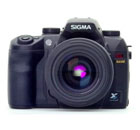 |
| Key Features | 14 megapixels, dust control | |
| Uniqueness | Foveon X3 Sensor | |
| Great For | Fine art and professional work | |
| Level | Advanced | |
| Avg. Kit Price | $850 | |
| Competitors | Canon 30D, Nikon D200 | |
| The SD-14 is Sigma's latest entry into the high-end digital SLR camera market. While its sensor packs in more megapixels than either the Canon 30D or the Nikon D200, its speed is significantly slower than both of those cameras. | ||
 Sony Digital SLR Sony Digital SLR |
Digital SLR Home |