Olympus Digital SLR Cameras
There used to be several Olympus digital SLR cameras available, but there aren't anymore.
Olympus has not released a new digital SLR since 2010 and that camera (the E-5) was more for professional photographers than amateurs.
Instead, Olympus has made the decision to focus their efforts on developing their line of mirrorless cameras, also know as Olympus PEN cameras. Olympus also has an SLR-like mirrorless camera called the OM-D E-M5.
While the PEN cameras have definitely done well in the mirrorless market, it's a shame that there have not been any new Olympus SLRs, although it does make sense.
When your three primary competitors are Canon, Nikon and Sony, it's challenging to release cameras that can capture the attention of the general public.
But for many years, Olympus did just that.
Olympus Digital SLR Firsts
Olympus never seemed content just releasing a minor upgrade to the camera that they released the previous year. Instead, they focused on creating some ground-breaking technology that eventually found its way into DSLRs from other companies.
For example, Olympus was the first to have a dust-control system inside their camera, to keep dust spots from appearing on the camera's sensor.
Second, they were the first to develop a live view LCD screen: one that behaved just like a compact camera, allowing you to take pictures using either the optical viewfinder or the LCD on the back of the camera. This was introduced on the E-330.
Finally, an Olympus digital SLR was the first to combine dust control, live view and built-in image stabilization (allowing you to shoot hand-held in very dim light) all into a single camera. This camera was the E-510.
What was also unique about Olympus digital SLRs was their adoption of a format called "Four Thirds."
The Four Thirds System
The Four Thirds system applies to both the connector between camera and lens (called the lens mount) as well as the type of digital sensor (it is neither a CCD nor a CMOS).
If you buy a Canon DSLR you have to buy Canon (or Canon-compatible) lenses to go with it. You can't take a Nikon or Pentax lens and stick it on your Canon camera because the point of attachment (the lens mount) isn't the same size.
But with the Four Thirds system, any digital camera that follows the standard can use any Four Thirds lens.
This means that you can use the same Four Thirds lens on digital SLR cameras made by different manufacturers. For example, you could take your Four Thirds lens and attach it to either an Olympus or a Panasonic camera since they both follow the standard.
As for the sensor, it is physically smaller than other DSLR sensors (which are often called APS-C sensors). The smaller sensor provides two advantages:
- Four Thirds cameras have smaller mirrors, which create less noise when they flip up out of the way of the sensor every time you take a picture
- Since they don't have to light up a giant sensor, Four Thirds lenses are smaller and lighter than lenses for APS-C cameras
Since the sensor is smaller, it results in a 2x multiplier (crop factor) applied to every lens that you use. This multiplier helps if you're into wildlife photography, but it's a drawback if you want to take landscapes and interiors.
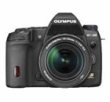
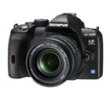
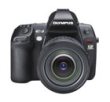
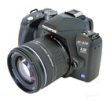
Discontinued Olympus Digital SLRs
As I mentioned at the start of this page, Olympus has not released a new digital SLR in some time. If you are the current owner of an Olympus DSLR looking to upgrade, there aren't a lot of options.
And if you're a newcomer to the world of digital SLR cameras considering an Olympus, just be aware that many of these cameras might be hard to find new.
Join Our Community!
- Learn more about your digital SLR camera
- Get other opinions about camera models
- Share your photos and get feedback
- Learn new DSLR tips and tricks